1. Intro to GridPath
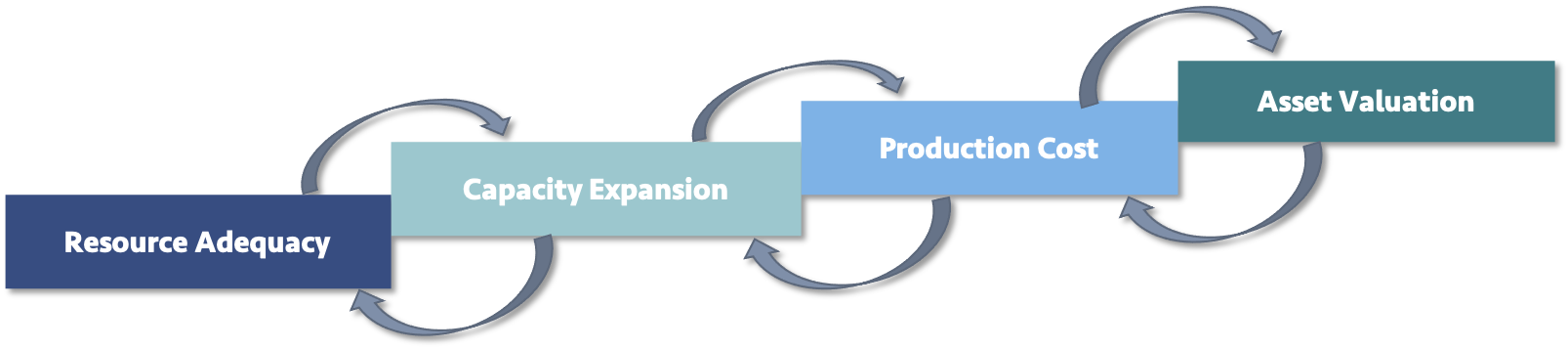
GridPath is a versatile grid-analytics platform that seamlessly integrates several power-system planning approaches – including production-cost, capacity-expansion, asset-valuation, and reliability modeling – within the same software ecosystem. As multiple approaches are often used sequentially or iteratively in system planning, the seamless interface among them within the same modeling platform reduces the labor-intensive data-translation requirements and can speed up insight-generation in the planning process.
1.1. Architecture
GridPath is built for today’s and tomorrow’s world, and can be easily adapted and extended: it has a highly flexible, modular architecture that facilitates its application to different systems and regions as well as the incorporation of emergent technologies and resources with non-standard characteristics (renewables, storage, demand response, and so on). This makes the GridPath platform well-equipped to quickly and seamlessly add critical functionality around new technologies, policies, or practices, in addition to full-featured traditional power system modeling.
Our goal is to create a transparent and user-friendly platform that facilitates quick model development and rapid adaptation. GridPath includes database-building tools, a results-visualization suite, and extensive validation and testing suites.
1.2. Functionality
GridPath’s modular architecture makes it possible to combine modules to create optimization problems with varying features and levels of complexity. Linear, mixed-integer, and non-linear formulations are possible depending on the selected modules.
GridPath has a highly flexible temporal and spatial span and resolution. Each generation, storage, and transmission asset in GridPath can be modeled with a user-specified level of detail. The decision for what to simplify and what requires a detailed treatment is left up to the user and can vary depending on the application of interest. GridPath’s flexibility and modularity facilitates its application to different systems and regions as well as to different planning questions.
GridPath can simulate the operations of the power system, capturing the capabilities of and constraints on generation, storage, and transmission resources to understand grid integration and flexibility needs. In capacity-expansion mode, GridPath can also identify cost-effective deployment of conventional and renewable generation as well as storage, transmission, and demand response. In asset-valuation mode, GridPath can determine the market performance of an asset or a set of assets.
The platform can optionally capture the effects on operations and the optimal resource portfolio of forecast error, provision of ancillary grid services, interconnection, reliability requirements such as a planning reserve margin or local capacity requirements, and policies such as a renewables portfolio standard (RPS) or a carbon cap.
The main variables fall into several categories:
Capacity: whether (generator, storage, and/or transmission) capacity should be built or retired?
Availability: when capacity can be made unavailable, e.g. for planned maintenance?
Operations: how should available (generator, storage, and/or transmission) capacity be operated?
The main constraints include:
Capacity: limits on the amount of capacity that can be deployed.
Availability: requirements for unavailable time, e.g. for maintenance.
Operations: limits on the operational capabilities of generation, storage, and transmission assets.
System: meeting load, operating reserves, and reliability requirements.
Policy: meeting policy targets such as an RPS or a carbon cap.
The objective function is typically to maximize system net present value, but other formulations are possible.
GridPath is under active development and we are continuously adding new functionality.